Which Claude Code or Codex run failed while I was away?
Without a tool, finding a failed run means opening each transcript and reading its tool output for errors. ACTVT lists every Claude Code and Codex session on your Mac and counts the failed tool calls in each one, like commands that exited with an error or files that weren’t there. Turn on the filter and you only see the runs where something failed. In the transcript, each failed call is shown in red, so you can find where a run went wrong without reading every log. The session browser and its filters are part of the Premium tier.
0:425 chapters
Step by step
0:00Three runs finished
Three agent runs finished while I was away, and I want to know if they all worked. ACTVT lists every Claude Code and Codex session on this Mac. I filter it to today, and there are the three, all finished.
0:19Show only the ones with errors
This filter leaves only the runs where a command failed, and that’s just one of them.
0:25How many calls failed
I open it, and two of its tool calls failed. That doesn’t mean the run failed, so let’s see what happened.
0:31Look at the failed calls
The failed calls are in red. First a fixture was missing, then there was a rounding bug. The agent fixed both and the tests pass, so the errors happened along the way and the run still finished fine.
0:39The other two were clean
When I turn the filter off, you can see the other two runs had no errors.
Questions
- What counts as failed?
- A tool call that errored, like a command that exited non-zero or a missing file.
- Is it free?
- The session browser and its filters are Premium.
More tutorials
All tutorials →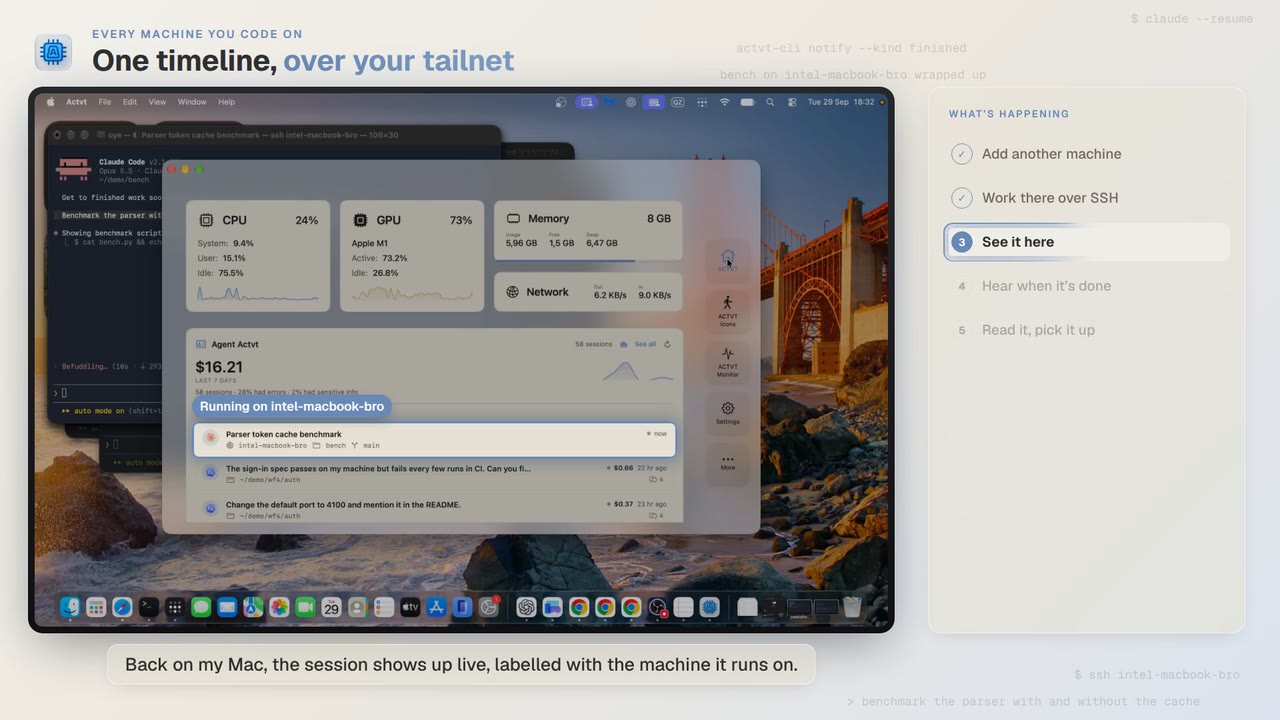 1:24
Every machine you code on
See Claude Code, Codex and pi sessions from all your machines over SSH
Start Claude Code on another Mac over SSH, and you can follow the session from your own Mac while it runs and read the whole transcript when it’s done.
 3:42
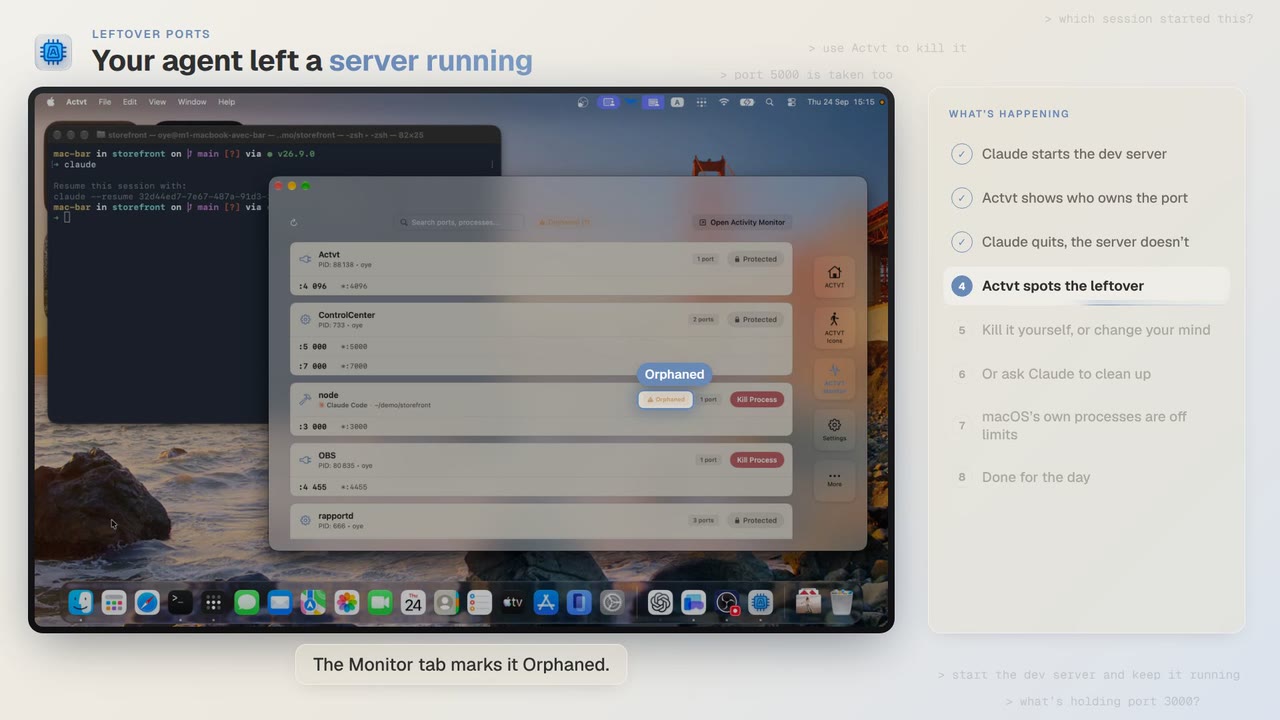
Leftover ports
Find and kill the dev server Claude Code or Codex left running
Claude Code starts a dev server and then quits, and port 3000 stays taken. ACTVT shows you the server whose session is gone and lets you free the port safely.
 0:48
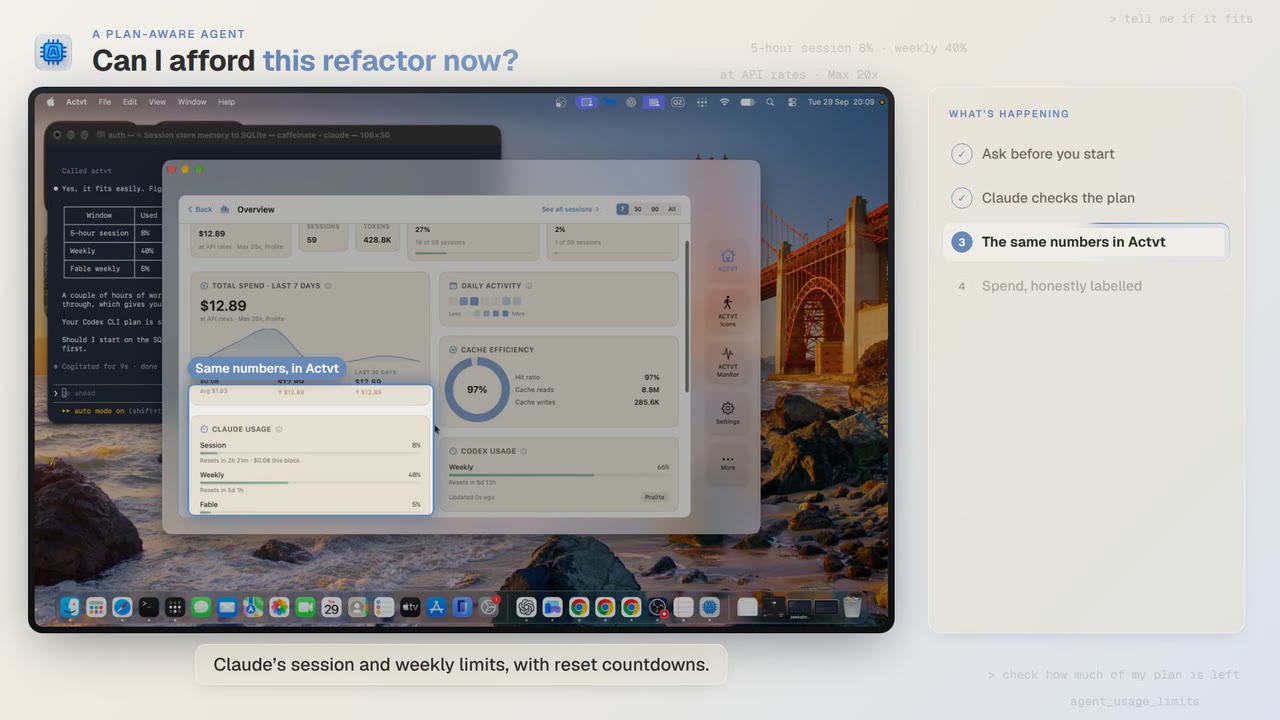
A plan-aware agent
Check your Claude and Codex plan limits before a long agent job
Before a two-hour job, Claude Code asks ACTVT how much of your plan is left. You can see the same limits in ACTVT, along with when each one resets.
Try it on your own agents
ACTVT is free to start, and reads the session files Claude Code, Codex CLI and Pi already write. Nothing to configure.